Pallet racking decommissioning in Texas is picking up. Post-COVID network reshuffling, lease expirations, and shifting fulfillment strategies are pushing operators to close, consolidate, or resize facilities across Dallas-Fort Worth and beyond. Most of those projects get treated as a line item on the cost side of the ledger: demo, disposal, write-off, move on.
That is a mistake.
This case study walks through how Conesco turned an 80,000 square foot Dallas 3PL decommission into a net-positive project. The team evaluated the existing racking and gravity conveyor, dismantled it without destroying resale value, remarketed the steel, and reinstalled a large share of it in a new facility with a layout built for higher throughput. The teardown funded the next build. Here is how that worked.
Project Kickoff and Evaluation
The facility was an 80,000 square foot 3PL operation in Dallas running at high occupancy. The racking was a mix of selective pallet racking and gravity conveyor lanes. The operator needed to exit the building on a defined timeline, and the default plan was a standard teardown with disposal.
Conesco started with a full evaluation before any steel came off the floor.
How the Evaluation Worked
The team graded every component on a condition scale, checking uprights, beams, gravity flow lanes, anchors, and bracing for damage, wear, and code compliance. Seismic and load ratings were verified against current standards. The goal was to sort everything into three categories: prime reuse, repairable, and scrap.
A high percentage of the steel qualified for reuse or resale. Uprights and beams that had been properly maintained were still structurally sound. Gravity flow lanes, which are often overlooked in teardowns, carried significant resale value on their own.
This is where a lot of decommission projects go wrong. Warehouse and safety professionals talk about “rip-and-run” teardowns where crews rush through the job, damage racks beyond reuse, and leave the operator with scrap value instead of resale value. The difference can be six figures on a project this size.
Conesco’s approach is the opposite. Methodical. Safety-led. Every component gets graded before a single bolt comes out.
Efficient Dismantling Tactics
Tearing down 80,000 square feet of racking is not just a labor job. It is a sequencing problem. The Dallas crew had to work around remaining operations, minimize product touches, and protect the steel so it would hold its resale value on the other side.
Sequencing the Teardown
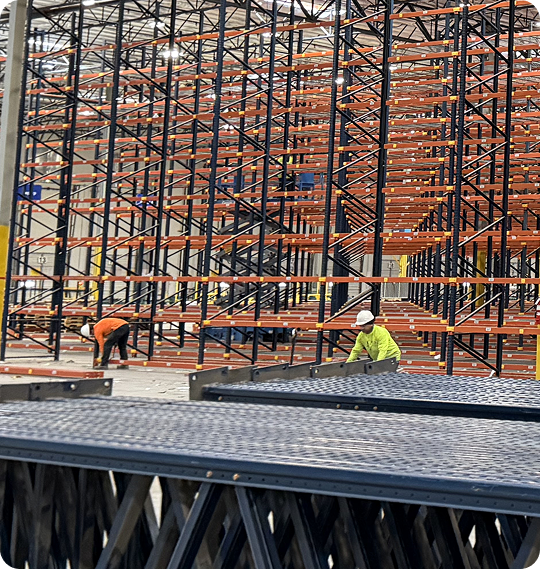
The crew worked in zones, starting with areas that were already cleared and moving toward active storage last. This let the operator keep running partial operations during the teardown window instead of shutting everything down at once. Each zone was dismantled, sorted, and staged before the next zone started.
Segregation on the Floor
As components came down, the crew segregated them by grade and type right on the warehouse floor. Prime reuse steel went to one staging area. Repairable components went to another. Scrap was separated out immediately. This sounds simple, but it makes a real difference downstream. When the steel is pre-sorted at the teardown site, resale and reinstallation move faster and cost less.
Common Pitfalls That Destroy Resale Value
There are a handful of mistakes that show up in teardowns over and over. Each one can cost an operator tens of thousands of dollars in lost resale value:
- Cutting bracing to save time. Bracing is structural. Once it is cut, the upright it was attached to may not be resalable. A few minutes saved on the floor can eliminate thousands of dollars in asset recovery.
- Bending base plates during removal. Forklift operators rushing to pull uprights off anchors will bend base plates. A bent base plate means the upright needs repair or goes to scrap.
- Mixing brands and specs. Different racking manufacturers use different beam-to-upright connections. When brands get mixed during teardown, the buyer has to sort it all again, or worse, discovers the mismatch during reinstallation.
The Dallas project avoided all three. The crew was trained to treat every component as a sellable asset, not debris.
Resale Maximization and ROI
With the steel graded, sorted, and staged, Conesco moved into remarketing. This is where a decommission project either pays for itself or stays a cost center.
Tapping Regional Demand
Texas is one of the strongest markets for used pallet racking in the country right now. 3PL expansion, ecommerce fulfillment buildouts, and new distribution nodes across Dallas-Fort Worth, Houston, and San Antonio are all creating buyer demand. Conesco leveraged its own buyer network and regional presence to move the reclaimed steel quickly.
Bundling the racking with the gravity conveyor was a smart play. Some buyers want turnkey packages, not piecemeal components. Offering selective racking and gravity flow lanes together attracted buyers who were building out new facilities and wanted to save time on sourcing.
The ROI Picture
The operator recovered meaningful capital from the steel and conveyor resale. On top of that, they avoided disposal costs that would have applied if the material had been scrapped. And a large share of the gravity conveyor was repurposed in the operator’s own next facility, which eliminated a purchase they would have otherwise made new.
Add those three lines together: capital recovered from resale, disposal costs avoided, and new-equipment purchases eliminated. What started as a teardown budget became funding for the next project.
If your decommission budget is all cost and no revenue line, you are leaving money in the steel.
Reinstall in a New, Higher-Throughput Layout
A large portion of the salvaged racking and gravity conveyor from the Dallas teardown was reinstalled in a new facility. But it did not go back in the same configuration. The layout was redesigned from scratch for higher throughput.
Optimizing for Case-Picking and Fulfillment
The new layout was built around case-picking and ecommerce-style fulfillment workflows. Pick paths were shortened. Gravity conveyor lanes were repositioned to reduce touches between storage and shipping. Selective racking was configured with tighter bay spacing in high-velocity zones and wider spacing in bulk storage areas.
This is a trend across the industry. Pallet racking market reports increasingly highlight the move toward high-density and automation-ready layouts. Operators are not just storing pallets anymore. They are designing storage systems that support hybrid automation, shuttle systems, and faster order cycles.
Same Steel, Smarter Layout
The steel itself was the same. The uprights, beams, and gravity flow lanes that came out of the 80,000 square foot Dallas facility went into the new one. But the layout made them work harder. The operator got a measurable improvement in throughput without buying a single new upright or beam.
That is where the real ROI of a decommission-to-reinstall project shows up. Not just in what you recover from the teardown, but in what you gain from the reinstall. Better pick paths. Fewer touches. A layout that matches your current operation instead of the one you inherited five years ago.
Lessons for Multi-Site Operators
This was one facility. One teardown. One reinstall. But the playbook scales. If you manage 5, 10, or 50+ sites, the principles compound.
Treat Racking as a Financial Asset
Most operators carry racking on the books as a depreciating fixture. That is an accounting treatment, not a reflection of reality. Structural steel holds value for decades when it is maintained and inspected. The moment you start treating your racking as a recoverable asset instead of debris, your decommission economics change.
Standardize Your Grading and Tagging
If you are running multiple sites, create a standard process for grading and tagging racking during any decommission. Use the same condition scale across every facility. Tag components by brand, spec, and grade before they leave the floor. This makes it dramatically easier to reuse steel across your own network or sell it to the secondary market.
Engage a Partner Who Follows the Steel
A decommission in Dallas might feed a reinstall in Houston, Chicago, or Atlanta. You need a partner who can handle permitting and engineering wherever the steel lands, not just where it starts. Conesco operates in Texas and nationally, with local crews, engineering support, and logistics built to move steel between sites.
Your decommission plan is as important as your new-build design. Treat it that way.
Your Next Decommission
If you are planning a facility closure, consolidation, or resize, it is worth understanding what your racking and conveyor are actually worth before the demo crew shows up. Conesco offers decommission audits that estimate recoverable value, project timeline, and potential reuse paths across your network.
Before you call the demo crew, call someone who knows what your pallet positions are worth.
Frequently Asked Questions
What happens to pallet racking when a warehouse closes?
The racking is typically dismantled and either scrapped, resold on the secondary market, or reused in another facility. The outcome depends on how the teardown is managed. A methodical approach with condition grading and proper dismantling preserves resale value. A rushed teardown often destroys it.
How do you determine if used racking is safe to resell or reuse?
Each component is inspected and graded on a condition scale. Uprights, beams, base plates, anchors, and bracing are checked for damage, wear, and structural integrity. Load ratings and seismic compliance are verified against current codes. Components that pass go to resale or reuse. Those that do not go to repair or scrap.
How much of a decommissioned warehouse’s racking can typically be reused?
It varies by facility age, maintenance history, and racking type. In well-maintained facilities, a high percentage of the steel, including uprights, beams, and flow lanes, can be reused or resold. The Dallas project in this case study recovered a large share of its racking and gravity conveyor for reinstallation.
What mistakes destroy the resale value of used pallet racking?
The most common are cutting bracing to speed up teardown, bending base plates during removal, and mixing brands or specs. Each of these can cost tens of thousands of dollars in lost recovery value on a mid-size project.
Can gravity conveyor be repurposed in a new facility?
Yes. Gravity conveyor lanes, rollers, and frames can be inspected, regraded, and reinstalled in a new layout. In the Dallas project, gravity conveyor was repositioned in the new facility to shorten pick paths and reduce handling touches.
How long does an 80,000 square foot warehouse teardown take?
Timelines depend on the complexity of the racking system, whether operations are still running in the building, and the level of sorting and grading required. A well-sequenced teardown with zone-by-zone dismantling and on-floor segregation can move efficiently without sacrificing resale value.
Does Conesco handle pallet racking decommissioning in Texas?
Yes. Conesco has regional crews and yard operations in Texas, with experience across Dallas-Fort Worth, Houston, San Antonio, and surrounding markets. They handle evaluation, dismantling, resale, and reinstallation.
Can decommissioned racking be re-engineered for a different facility layout?
Yes. Used racking can be reconfigured and re-engineered for a new layout, including different bay spacing, beam levels, and load ratings. The steel is the same. The layout is designed from scratch to match the new operation’s workflow and throughput requirements.
Is it cheaper to just scrap old racking and buy new?
In most cases, no. Scrapping means you absorb the full disposal cost and then pay top-of-market prices for new steel. A decommission-to-resale or decommission-to-reinstall approach recovers capital, avoids disposal costs, and often eliminates the need to purchase new systems.
What if the racking brands do not match at the new site?
Brand compatibility is checked during the evaluation phase. Different manufacturers use different connection types. A good supplier will identify compatibility issues upfront and either source matching components or engineer a solution that works with the existing system at the destination site.
Key Takeaways
- Evaluate your racking before you tear it down. Condition grading and code checks determine whether you are sitting on scrap or a six-figure asset.
- Sequence your teardown to protect resale value. Cutting corners during dismantling, like severing bracing or bending base plates, destroys recoverable capital.
- Segregate materials by grade and type on the floor during teardown. Pre-sorted steel moves faster and costs less to resell or reinstall.
- Think of your decommission as project funding, not a cost center. Capital recovered from steel resale plus avoided disposal costs can offset your next facility buildout.
- Reinstall with a better layout, not the same one. The real ROI is in shorter pick paths, fewer touches, and a configuration that matches your current operation.
- Multi-site operators should standardize racking grades and engage a partner who can follow the steel across locations, handling permitting and engineering wherever it lands.

Ted Hodges - CEO & Founder
Ted Hodges is the Founder and CEO of Conesco Storage Systems, a company he started in 1986 to provide turnkey warehousing products and services, including the repurposing of quality, used material handling equipment. With over 40 employees across the country, Ted and his team serve customers of all sizes throughout the different stages of the warehousing lifecycle.