Your warehouse layout has an expiration date. Supply chains shift. SKU mixes change. Order volumes spike or drop. And the racking configuration that worked three years ago starts creating bottlenecks you can feel in every pick cycle.
Warehouse facility reconfiguration is the process of reorganizing your racking, equipment, and floor plan to match current operational demands without relocating to a new building. It is one of the fastest ways to recover capacity, cut costs, and extend the life of your existing space.
This guide walks through the full reconfiguration process, from assessment to installation, using a real multi-site project as a working example. One company ran five to six reconfiguration projects across four locations at the same time, including sorter removal, mezzanine relocation, shelf-level changes, and over 500 new uprights installed. All of it was done using a mix of used and new pallet racking to keep costs down and timelines tight.
Here is how to do the same thing for your operation.
Why Warehouses Outgrow Their Layouts
Warehouse layouts go stale for a few reasons. Product lines change. Order profiles shift from full-pallet to case-pick. E-commerce growth forces faster fulfillment cycles. And equipment that was state-of-the-art five years ago starts dragging operations down.
The market has made this worse in recent years. During the COVID surge in 2020 and 2021, demand for racking skyrocketed. Lead times for new domestic manufacturers stretched to 18-20 weeks. Companies bought whatever they could get. Then the correction hit. By 2023 and 2024, oversupply flooded the market. Companies downsized, exited leases, and started selling off equipment they no longer needed.
That cycle created a massive opportunity for warehouses that need to reconfigure. There is more quality used racking available on the secondary market right now than at any point in recent memory. And with domestic steel prices climbing again and tariff uncertainty affecting import costs, buying used can save you 30-50% compared to new.
But the savings only work if you plan the reconfiguration right.
How to Assess Your Current Layout
Every reconfiguration starts with an honest look at what you have and what is not working.
Identify the Bottlenecks
Walk the floor. Where is product backing up? Where are workers taking extra steps? Where is overflow happening?
In the multi-site project referenced above, one of the first red flags was pallet racking stored in the parking lot. That is a clear sign of maxed-out interior capacity. Another was an aging sorter system, a large automated conveyor that routes products to chutes for workers to pick from. The sorter was outdated and eating up valuable floor space that could hold racking.
Map Your Material Flow
Look at product velocity. What moves fast? What sits? Where does receiving hand off to storage, and where does storage hand off to picking and shipping?
The goal is to understand how product flows through your building so you can design a layout that matches reality, not a layout based on how operations worked two or three years ago.
Run the Numbers on Your Existing Equipment
Assess the condition and specs of your current racking. Upright heights, beam lengths, load capacities, wire deck sizes. Know what you have so you can figure out what is reusable, what needs to be relocated within your building, and what needs to go.
Tools for this phase include site visits, CAD analysis, and safety audits. If your facility is large or complex, bring in a team that does this at scale. Conesco’s nationwide teams run these assessments across the country, from their headquarters in Centennial, CO to offices in Phoenix, AZ, California, New Jersey, Minneapolis, and Utah.
How to Plan a Warehouse Reconfiguration
Once you know what is broken, you can design what replaces it.
Design the New Layout in CAD
CAD drawings are non-negotiable. They tell you exactly how many pallet positions you can fit, where uprights go, what beam levels work for your product mix, and where to preserve floor storage.
In the multi-site project, one location needed 500 new uprights and beams installed in a section of the warehouse while keeping floor storage intact in adjacent areas. Without CAD, that level of precision is not possible. You end up guessing, and guessing leads to rework.
Source Used Racking Early
This is where the real cost savings happen. Used pallet racking in good condition can cost 30-50% less than new, depending on availability and specs.
On a $1 million racking project, that is $200,000 to $500,000 in savings. That is real money you can put toward labor, permitting, or the next facility launch.
The key is sourcing early. If you know you are launching or reconfiguring in six months, start procurement now. Used racking availability shifts with the market. Right now, there is a healthy supply, particularly in markets like California. But that can change fast.
Some operators will store sourced racking at a staging facility for a few months until the build-out is ready. That storage might cost $4,000 to $5,000 per month, but it locks in your pricing and availability.
Handle Permitting Before You Start
High-pile storage permits are required in most jurisdictions when you change racking height or configuration. This is not optional. Skipping it creates inspection problems down the line that can shut down your operation.
Get stamped engineering drawings as part of your planning phase. Conesco provides these as part of their facility reconfiguration service, which keeps the permitting process moving alongside the physical work.
Execute the Reconfiguration in Phases
Trying to reconfigure an entire warehouse at once is a recipe for downtime and chaos. Phase the work.
Phase 1: Decommission and Dismantle
Start by removing what needs to go. Old equipment, outdated systems, racking that is being relocated or sold.
In the case study project, Phase 1 involved removing a large automated sorter system that was no longer performing. That sorter was failing to integrate with the company’s warehouse management system, and the vendor that installed it was headed toward a lawsuit over the integration failures. Ripping it out freed up a massive footprint for new racking.
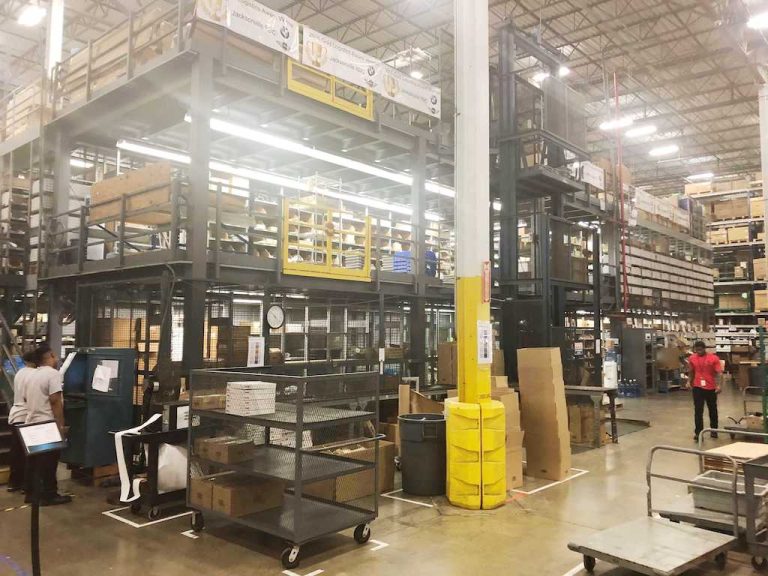
The same phase included relocating a mezzanine from one end of the building to the other. That is a significant structural move that requires engineering and labor coordination.
Everything removed gets inventoried. Racking and equipment in sellable condition goes to the secondary market. This offsets project costs. A 700,000-square-foot decommission can yield $1 million or more in material value, depending on the equipment inside.
Phase 2: Relocate and Install
With cleared space, the new racking goes in. This is where used and new components get integrated.
In the case study, this meant bringing pallet racking from the parking lot back into the warehouse, installing 500 new uprights and beams, and adjusting shelf levels on existing racking across multiple sites. Each location had slightly different needs, but the overall approach was the same: maximize pallet positions, preserve floor storage where needed, and keep operations running during the install.
Phase 3: Test and Optimize
After installation, run flow tests. Move product through the new configuration and look for snags. Check safety compliance. Make sure your permitting inspections pass.
This phase catches small problems before they become big ones. A beam set at the wrong height, a wire deck that does not fit the product, an aisle width that pinches forklift traffic. Catch it now, fix it now.
Target: minimize downtime to less than one week per section.
Real-World Results: Multi-Site Reconfiguration Case Study
Here is what a phased reconfiguration looks like across a real multi-site operation.
This company came to Conesco with five to six distinct projects across four locations. Each project had different requirements, but Conesco managed them as a coordinated rollout:
- Parking lot racking removal. Excess racking stored outside was brought in and reinstalled where it was needed.
- Automated sorter removal. An outdated sorter that could not integrate with the company’s inventory management system was torn out. The space was converted to racking.
- Mezzanine relocation. A mezzanine was moved from one end of a facility to the other to support a new workflow.
- Shelf-level adjustments. Existing racking across multiple sites had beam heights reconfigured to match current product dimensions.
- New racking installation. Over 500 uprights and beams were added in cleared areas while preserving adjacent floor storage zones.
- Floor storage preservation. The new layout maintained open floor areas for bulk or non-racked product alongside the new racking.
The result: more capacity, lower cost than buying all-new equipment, and no catastrophic integration failures from over-engineered “smart” systems.
That last point matters. Automated and robotic systems can deliver huge efficiency gains when they work. But when they fail to integrate with your WMS or ERP, the fallout is expensive. This company learned that lesson with their sorter. The reconfiguration gave them a simpler, more reliable setup that they control.
Cost and ROI: What to Budget For
Reconfiguration costs break down into a few buckets.
Used racking material: 30-50% less than new, depending on condition, spec match, and market availability. When domestic steel prices rise and new manufacturer lead times stretch to 4-8 weeks, used becomes even more attractive.
Labor: Plan for labor to account for roughly 20% of your total project budget. This covers dismantling, relocation, and installation.
Permitting: Depending on jurisdiction and scope, budget $5,000 to $20,000 for permits, stamped drawings, and inspections.
ROI timeline: Most well-planned reconfigurations pay for themselves within 6-12 months through efficiency gains of 15-25%.
Here is the math that makes it work. If you are spending $1 million on a full facility racking project and you source used at 40% savings, you just freed up $400,000. That covers your labor, permitting, and project management with room to spare.
Common Pitfalls That Derail Reconfiguration Projects
Ignoring Integration Issues
The case study company’s sorter is a perfect cautionary tale. The vendor installed a complex automated system that could not talk to the warehouse management software. The result was a system nobody could use and a legal dispute.
Before you invest in any “smart” equipment, make sure it integrates with your existing systems. If you cannot get a clear integration plan from the vendor, that is a red flag.
Skipping Permits
Every municipality has different requirements for high-pile storage. Some are lenient. Some will shut you down mid-operation if your permit does not match your racking layout. Get your permits squared away before the first upright goes in.
Rushing Without CAD
Eyeballing a racking layout is tempting when you are under pressure to get a facility back online. Do not do it. CAD drawings cost a fraction of what rework costs, and they catch problems that are invisible on the warehouse floor.
Undervaluing Your Existing Assets
When you tear out racking or equipment, that material has value. Do not scrap it or give it away. Used pallet racking has a strong secondary market, and decommissioned equipment can offset a significant portion of your reconfiguration costs if you sell it through the right channels.
Trying to DIY Large Teardowns
In-house labor or temp workers without racking experience create safety risks and can damage equipment. Damaged uprights and beams lose resale value and can fail structural inspections. Use licensed professionals for anything beyond basic shelf-level adjustments.
When to Call a Reconfiguration Partner
You can handle small projects in-house. Adjusting beam levels on a few rows, adding wire decks, swapping out damaged uprights. That is straightforward.
But when the scope involves multiple phases, structural changes like mezzanine relocation, equipment removal, permitting, and used racking procurement, you need a partner with the infrastructure to manage all of it.
Conesco operates from offices across the country: Centennial, CO (headquarters), Phoenix, AZ, California, New Jersey, Minneapolis, and Utah. That footprint means a team can be on-site fast, and multi-site rollouts like the case study above can run in parallel instead of sequentially.
What to look for in a reconfiguration partner:
- Experience with used pallet racking sourcing and pricing
- In-house labor for dismantling, relocation, and installation
- Engineering capability for stamped drawings and CAD layouts
- Permitting knowledge across jurisdictions
- Project management for multi-phase, multi-site work
- A buyback program for the equipment you are removing
Frequently Asked Questions About Warehouse Facility Reconfiguration
What is warehouse facility reconfiguration? Warehouse facility reconfiguration is the process of reorganizing racking, equipment, and floor plans within an existing warehouse to match current operational needs. It can include racking relocation, shelf-level adjustments, equipment removal, new racking installation, and mezzanine moves. The goal is to improve capacity and efficiency without relocating to a new building.
How much does pallet racking reconfiguration cost? Costs vary by scope. Used racking material runs 30-50% less than new. Labor typically accounts for around 20% of the total budget. Permitting can range from $5,000 to $20,000 depending on jurisdiction. A full facility reconfiguration for a mid-size warehouse (80,000-200,000 sq ft) can range from $100,000 to over $1 million.
How long does a warehouse reconfiguration take? Timelines depend on scope and phasing. A single-section racking change might take a few days. A multi-site, multi-phase project like the case study in this article can run over several months. Phased execution keeps downtime per section to under one week.
Can I reuse my existing pallet racking during a reconfiguration? Yes. In fact, reusing existing racking is one of the primary cost-saving strategies. Uprights, beams, and wire decks in good condition can be relocated within your facility or supplemented with used racking sourced from the secondary market. A condition assessment determines what is reusable and what needs replacement.
Do I need permits to reconfigure warehouse racking? In most jurisdictions, yes. Any change to high-pile storage height or layout typically requires an updated permit. This includes adding racking, changing beam levels, or relocating racking to new areas of your building. Stamped engineering drawings are usually part of the permit application.
What is the difference between reconfiguration and decommissioning? Reconfiguration reorganizes a warehouse that stays operational. Decommissioning is the full teardown and removal of equipment from a facility that is being closed, downsized, or vacated. Some projects involve both. The case study in this article included decommissioning an old sorter system as part of a broader reconfiguration.
How much can I save by using used pallet racking instead of new? Savings range from 30-50% compared to new domestic racking, depending on market conditions, specs, and equipment condition. On a $1 million project, that translates to $300,000-$500,000 in savings. With domestic steel prices rising and tariff uncertainty on imported racking, used is an increasingly strong option.
What happens to removed equipment during a reconfiguration? Equipment removed during reconfiguration can be sold on the secondary market, offsetting project costs. Racking, mezzanines, conveyor, forklifts, and specialty equipment all have resale value. A professional partner will inventory removed materials and help you sell or liquidate them.
Can reconfiguration happen while my warehouse is still operating? Yes. Phased execution is the standard approach. Work happens section by section so the rest of the warehouse keeps running. The case study company ran multiple reconfiguration phases across four locations without shutting down operations.
How do I know if my warehouse needs reconfiguration vs. a new facility? If your building still has the square footage and clear height to support your operations but your layout is the problem, reconfiguration is usually the right call. Signs include overflow storage in parking lots or trailers, inefficient pick paths, outdated equipment consuming floor space, and racking that does not match your current product mix. A new facility only makes sense when the building itself is the constraint.
Key Takeaways
- Start every reconfiguration with a full assessment: racking condition, material flow, bottlenecks, and equipment inventory
- Use CAD drawings for new layouts. Skipping this step leads to costly rework.
- Source used pallet racking early. The secondary market offers 30-50% savings, but availability shifts with market conditions.
- Phase your execution. Decommission first, then relocate and install, then test. Keep downtime under one week per section.
- Budget for labor (roughly 20% of total) and permitting ($5K-$20K) from the start.
- Sell removed equipment through the secondary market to offset project costs.
- Work with a reconfiguration partner that handles procurement, engineering, labor, permitting, and project management under one roof.

Ted Hodges - CEO & Founder
Ted Hodges is the Founder and CEO of Conesco Storage Systems, a company he started in 1986 to provide turnkey warehousing products and services, including the repurposing of quality, used material handling equipment. With over 40 employees across the country, Ted and his team serve customers of all sizes throughout the different stages of the warehousing lifecycle.