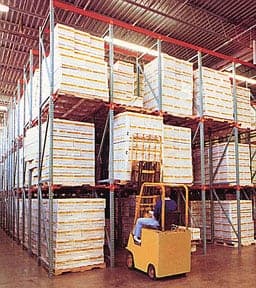
Getting pallet racking permits in Maricopa County isn’t optional when your storage systems exceed 5 feet 9 inches. The permit process involves both the Maricopa County Planning & Development Department and local fire authorities, with requirements that change based on your rack height, storage type, and location.
Missing these permits can shut down your operation. The county can issue fines, halt your warehouse activities, or order you to remove installed equipment until you achieve compliance.
This guide walks through the exact permit requirements, documentation needs, and submission process for warehouse racking in unincorporated Maricopa County and Phoenix.
Understanding Maricopa County Racking Permit Requirements
Maricopa County divides pallet racking into three permit categories based on height and configuration. Each category carries different documentation requirements and review processes.
Small Racking Systems Under 5’9″
Warehouse racks at or below 5 feet 9 inches are exempt from permits under International Building Code Section 105.2. You can install these systems without submitting plans or paying fees.
This exemption applies only to the structural racking permit. If you’re storing combustible materials, fire code requirements may still apply based on your storage configuration and square footage.
Medium Racking Between 5’9″ and 12 Feet
Racks between 5’9″ and 12 feet trigger permit requirements, but you can use a simplified process if your system meets specific conditions. Your height-to-depth ratio must stay under 8, with total weight per level under 2,500 pounds, in a Risk Category I or II structure.
For these medium systems, you need floor plans showing rack locations, exits, and aisle widths. Elevation drawings must include dimensions and weight loads for each level. You’ll submit anchor and baseplate calculations, a structural special inspection certificate, and documentation showing where manufacturer load plaques will be placed.
The county can process these as Permit by Inspection applications with a potential structural over-the-counter review. This speeds up approval compared to full plan review cycles.
Fire permits may still be required depending on what you’re storing and how high you’re stacking it. The 12-foot threshold triggers additional fire code scrutiny.
Large Systems and High-Pile Storage Over 12 Feet
Any racking configuration that doesn’t meet the simplified criteria requires complete structural documentation. This includes full rack calculations, seismic calculations, and both building and fire permits.
When you’re storing materials over 12 feet high, you enter high-pile storage territory. This requires high-piled storage evaluation forms with product flammability details, commodity class information, fire sprinkler data, and concrete specifications.
High-hazard commodities like rubber tires, Group A plastics, flammable liquids, and idle pallets trigger high-pile requirements at just 6 feet of storage height instead of 12 feet. These materials create higher heat-release rates during fires and demand more stringent protection systems.
Storage areas exceeding 500 square feet of high-pile space require separate fire permits beyond your structural racking permit. The 500 square feet includes operating aisles, not just the rack footprint.
Determining Your Jurisdiction in Maricopa County
Your first step is verifying whether your project falls under unincorporated Maricopa County or an incorporated city. This determines which agency reviews your plans and which portal you use for submission.
Incorporated cities like Phoenix, Mesa, Scottsdale, and Tempe handle their own permitting through city planning departments. Each city maintains separate portals, fee schedules, and local code amendments. If your warehouse sits within city limits, you apply directly with that city.
Unincorporated Maricopa County uses the Maricopa County Planning & Development Department for all racking permits. The department operates from 501 N. 44th Street, Suite 200, Phoenix, AZ 85008, with permit questions handled at 602-506-3301.
The county processes everything through their online Permit Center at maricopa.gov. You create an account, submit your racking plans and structural documents as PDFs, and the system routes your application to building, structural, and fire reviewers.
Phoenix operates on different code cycles than unincorporated areas. The city adopted the 2024 International Building Code effective August 1, 2025, while unincorporated Maricopa County uses the 2018 IBC. This affects which seismic reference standards apply to your engineering calculations.
Required Engineering Documentation for Maricopa County
All racking permits over 5’9″ require documents signed and sealed by an Arizona-registered professional engineer. The engineering package must demonstrate structural integrity and seismic safety specific to your location.
Design Drawings and Plans
Your CAD drawings need to show overall floor plans with rack locations, aisle widths, and exiting systems. Elevation drawings must detail the height, width, and depth of each rack type with complete dimensions.
Include the assessor parcel number, site address, and engineer’s contact information on every sheet. Drawings must use standard engineering scale and clearly mark all structural elements.
Both longitudinal elevations (down-aisle view) and transverse elevations (cross-aisle view) are required. These show how racks are configured in both directions and help reviewers understand the complete system layout.
Structural and Seismic Calculations
Licensed engineers must calculate the rated capacity to withstand design structural loads including seismic activity. Maricopa County sits in an active seismic zone, so all designs must account for ground shaking forces.
Seismic values aren’t fixed across the county. Engineers use the official USGS hazard tool to determine exact values based on your project coordinates. Typical mapped spectral acceleration at short periods ranges from 0.17g to 0.30g across the Phoenix metro area, with 1-second period values between 0.06g and 0.08g.
Most sites are classified as Site Class D representing stiff soil unless geotechnical reports prove otherwise. This soil classification adjusts the mapped values to produce design spectral accelerations typically between 0.25g and 0.45g for short periods.
Standard occupancy buildings and racking systems usually fall into Seismic Design Category B or C. This indicates moderate expected ground shaking and requires specific anchorage to prevent collapse.
Unincorporated Maricopa County uses ASCE 7-16 as the seismic reference standard through the 2018 IBC. Phoenix references ASCE 7-22 through the 2024 IBC. Your engineer must apply the correct standard based on your jurisdiction.
Anchor and Baseplate Specifications
Anchor calculations must demonstrate resistance against seismic shear, tension from uplift, and overturning forces. These calculations follow standards from the International Building Code, ASCE 7, ANSI/RMI MH16.1, and ACI 318.
Baseplate sizes typically start at 5″x5″ minimum but increase in high-seismic areas to distribute concentrated loads across more concrete surface area. The engineer calculates the exact size and thickness needed based on column loads and anchor spacing.
Anchor strength calculations cover both tensile and shear capacity. Tensile calculations show the anchors can resist direct tension and overturning without pulling out of the concrete slab. Shear calculations confirm the anchors resist lateral forces during seismic events.
Embedment depth into the slab is critical for preventing concrete failure around anchor points. Engineers must verify minimum embedment and confirm adequate edge distance from slab edges or control joints to prevent breakout.
The calculations specify exact anchor types, diameters, grades, and manufacturer-specific products. Common options include adhesive anchors or expansion anchors, with the choice depending on slab conditions and load requirements.
For racks with height-to-depth ratios over 6, special calculations are required. These must show anchorage can handle a 350-pound live load at the top shelf of an entirely empty frame directed perpendicular to the aisle, per MH16.1 Section 8.1.
Floor Capacity Verification
Your engineer must verify the existing concrete slab can support the concentrated loads from rack baseplates. This requires information on slab thickness and concrete compressive strength measured in PSI.
Common floor capacity in Phoenix warehouses ranges from 5,000 to 7,000 PSF. Special heavy storage applications may require higher capacity slabs. If your existing floor can’t handle the loads, you’ll need slab reinforcement before rack installation.
Load combinations must follow ASCE 7 factored combinations. A typical combination might be 1.2D + 1.0E + L, where D represents dead load, E represents seismic load, and L represents live load. This ensures the design accounts for the most critical loading scenarios.
Phoenix Fire Permit Requirements for Racking
Phoenix requires separate fire permits when your racking creates high-piled combustible storage conditions. These fire permits are in addition to your building permit, not instead of it.
When Fire Permits Apply
An operational fire permit is required when you have more than 500 square feet of high-piled storage area including aisles. High-piled combustible storage means combustible materials on racks, pallets, or shelves where the top of storage exceeds 12 feet.
High-hazard commodities trigger the requirement at just 6 feet of storage height. These include rubber tires, Group A plastics, flammable liquids, and idle pallets stacked in your facility.
Phoenix uses the amended 2018 International Fire Code for enforcement. The specific trigger appears in Section 105.6.22 requiring an operational permit when high-piled combustible storage exceeds defined thresholds.
Construction vs. Operational Fire Permits
Phoenix requires two separate fire permits for high-pile storage. The F102 Construction Permit covers layout, sprinklers, and protection system design. You submit this through Planning & Development during the building phase.
The F303 Operational Permit comes from Phoenix Fire Department for ongoing use of your storage configuration. This permit needs renewal as required by the fire department and addresses how you actually operate the storage area.
Your building structural permit for the racking itself doesn’t replace these fire permits. All three permits can be required simultaneously for large racking projects.
Phoenix Fire Code Chapter 32 Requirements
Chapter 32 of the Phoenix Fire Code governs all high-piled combustible storage design, installation, and protection. Section 3201.3 lists what must appear in high-pile plans including floor plans, storage heights, rack layouts, aisle dimensions, commodity classification, and sprinkler criteria.
Section 3201.4 requires a fire safety and evacuation plan where Section 403 applies. This plan must be submitted for review and maintained on-site at your facility.
Section 3203 establishes commodity classification systems. Materials are classified as Class I, II, III, IV, or high-hazard based on their fire characteristics. This classification drives protection requirements.
Sections 3206.2 and 3206.2.1 determine the type and extent of protection. Required fire safety features must extend at least 15 feet beyond the high-piled storage area or to a full height wall. Where you have different storage types requiring different protection levels, the most restrictive requirements apply to the entire area.
Storage areas exceeding 500,000 square feet trigger Section 3206.2.2, requiring a technical report prepared by an Arizona Professional. Storage heights over 40 feet fall under Section 3206.2.3 and also require professional technical reports.
High-Hazard Commodity Classifications
High-hazard commodities create higher heat-release rates than ordinary Class I-IV materials. Phoenix expects these materials to be properly classified before you design rack layouts and select sprinkler criteria.
Group A plastics represent the most common high-hazard commodity in warehouses. These plastics burn intensely and can overwhelm standard sprinkler protection designed for ordinary commodities.
Once your product qualifies as high-hazard, allowable storage area shrinks, maximum storage height drops, and required protection intensifies. You may need in-rack sprinklers in addition to ceiling sprinklers, along with enhanced smoke and heat removal systems.
The high-hazard designation at 6 feet instead of 12 feet means you can trigger full high-pile storage permitting and protection requirements at relatively low storage heights. Classifying your products correctly from the start prevents expensive redesigns after plan review.
High-Pile Storage Documentation Requirements
High-pile storage submittals in Phoenix follow a sequential process with four separate submissions. Missing this sequence causes delays and resubmission requirements.
Sequential Submittal Process
First, submit HPS structural racking systems to Planning & Development referencing TRT document 00701. This covers the racking structure itself.
Second, submit building fire sprinkler and fire alarm system plans. These plans must show coverage adequate for your storage configuration and commodity type.
Third, submit the FPPD package to PDD for the F102 Construction Permit. This is where your high-pile storage layout and protection design gets reviewed.
Fourth, submit the FPPR package to Phoenix Fire Department for the F303 Operational Permit. The fire safety and evacuation plan goes in this submittal, not the F102.
Transmittal Letter Contents
Your transmittal letter must include a project process description explaining the overall workflow. Add a scope of work section detailing what you’re installing.
If any item on the plan submittal checklist doesn’t apply to your project, explain why in the transmittal letter. Reviewers need to know you didn’t accidentally omit required information.
Required Plan Elements
Elevation plans must show usable storage height for each storage area, number of tiers within each rack, and commodity clearance between the top of storage and sprinkler deflectors for each arrangement.
Include a Hazardous Material Inventory Statement if you’re storing regulated materials. Mark locations and dimensions of all high-piled storage areas on your floor plans.
Sprinkler design criteria must comply with PFC 3206.4.1.3 for all high-piled combustible storage areas. Document the aisle dimensions between each storage array and maximum pile volume if not stored on racks.
Describe and classify your commodities per Section 3203. State whether items are banded or encapsulated. If high-hazard commodities are present, clearly identify them.
Show locations, dimensions, and hardware information for required fire department access doors. Identify the type of fire suppression and detection systems you’re installing.
Mark valve locations controlling the water supply for both ceiling and in-rack sprinklers. Show the type, location, and specifications of smoke removal and curtain board systems.
Dimension and locate both transverse and longitudinal flue spaces in your rack configuration. State whether high-piled storage areas are accessible to the public, as this affects Table 3206.2 requirements.
Indicate exit access travel distances per Table 1017.2 of the 2018 IBC. Mark dead-end distances if Section 3206.10.3 applies to your layout.
Provide a detail drawing for the Automatic Sprinkler System Capabilities and Limitations Placard required by Section 3206.4.1.7. Show fire extinguisher locations and ratings per Section 3206.11.
Submitting Your Permit Application
The application process moves entirely through online portals in Maricopa County. Paper submissions are not accepted for racking permits.
Creating Your Permit Center Account
Navigate to maricopa.gov and locate the Permit Center portal. Create an account using your business information and contact details. This account stays active for all future permit applications.
The system requires PDF uploads for all documents. Scan or save your engineered drawings, calculations, and specifications as individual PDF files before starting your application.
Application Preparation
Gather rack layout plans showing the complete installation footprint. Collect manufacturer specifications for all racking components including load ratings and material certifications.
Verify your Arizona-licensed professional engineer has stamped and signed all structural calculations. Missing stamps are the most common cause of application rejection during initial review.
Prepare your Engineering Design Report, Engineering Calculations and Design Data, and Design Drawings as separate PDF packages. Each should be clearly labeled with the project address and submittal date.
For high-pile storage applications, complete the fire safety documentation before submitting. Trying to add fire protection details after structural review begins causes delays.
Plan Review Process
Once submitted, your application routes to multiple reviewers. The Planning & Development Department checks zoning, structural, and drainage compliance. Fire authorities review all fire safety elements simultaneously.
Plan review is iterative. Expect multiple rounds of comments and revisions, especially on first-time submittals. Reviewers mark up your plans with specific correction requests.
The most common delay comes from incomplete documentation. Missing engineer stamps, incorrect calculation formats, or outdated code references all trigger resubmittal requirements.
Phoenix reviewers specifically check that Chapter 32 and relevant subsections are explicitly referenced in your plans. Your design narrative should cite specific fire code sections that apply to your configuration.
Fee Payment and Permit Issuance
After reviewers approve all plan elements, the Permit Center calculates fees based on project valuation and scope. Fee schedules differ between unincorporated Maricopa County and incorporated cities.
Pay fees directly through the Permit Center portal using a credit card or electronic check. The system won’t issue your permit until payment clears.
Once fees are paid and all reviews are complete, the building permit is issued electronically. Download and print copies for your installer and for on-site posting during construction.
Inspection Requirements During Installation
Racking installation requires multiple inspections at specific stages. Scheduling these inspections correctly prevents work delays and keeps your project moving.
Special Anchor Inspections
Seismic anchors require a dedicated special inspection by an independent testing company. This isn’t a standard city inspector visit—you must hire a licensed engineer or qualified special inspector.
The special inspection confirms baseplates and anchors are installed correctly into the concrete slab. Inspectors check embedment depth, edge distances, anchor torque, and baseplate placement.
This inspection must occur before racks are loaded. Once pallets are stacked on beams, inspectors can’t verify the anchor installation underneath.
Schedule the special inspection through your Permit Center account or by calling 602-506-3301. The inspector needs at least 24-48 hours notice depending on their availability.
You’ll receive a structural special inspection certificate documenting that anchors meet the engineered specifications. This certificate must be submitted before moving to subsequent inspection stages.
Sequenced Inspection Schedule
Racking projects follow a sequenced inspection schedule similar to building construction. Foundation inspections verify slab preparation and anchor layout before installation.
Framing inspections occur after uprights and beams are installed but before loading. Inspectors check that the installed configuration matches approved plans.
Fire anchor inspections confirm that anchor spacing and placement meet fire code requirements where fire-rated assemblies are involved.
Final inspections verify the complete installation including load plaques, aisle widths, egress pathways, and fire protection integration.
Keep approved plans on-site during all inspections. Inspectors compare the physical installation against the stamped drawings to confirm compliance.
Final Inspection and Approval
The final inspection confirms your racking system is fully installed, properly anchored, and meets all permit conditions. Inspectors verify manufacturer load plaques are permanently affixed in conspicuous locations.
Each load plaque must be at least 50 square inches and clearly state maximum rated capacity for each shelf level and the entire unit. These plaques are required by RMI standards MH16.1 Section 1.4.2 and MH16.3 Section 1.4.2.
Inspectors check that aisle widths match approved plans and provide adequate space for your material handling equipment. Exit routes must remain clear and unobstructed per fire code requirements.
After passing final inspection, you receive approval to load and operate your racking system. For high-pile storage installations, the racking final must be complete before the facility can receive its Certificate of Occupancy.
Common Permit Pitfalls and How to Avoid Them
Most permit delays stem from preventable documentation errors or jurisdictional confusion. Understanding these common issues helps you avoid expensive corrections.
Jurisdiction Verification Issues
Warehouse facilities near city boundaries often face jurisdiction confusion. A site that appears to be in unincorporated county may actually fall within Phoenix city limits due to annexation.
Verify your exact jurisdiction before preparing any permit documents. Submitting to the wrong agency means starting over with a new application under different code requirements.
City and county use different code editions. Phoenix uses the 2024 IBC while unincorporated Maricopa County uses the 2018 IBC. Engineering calculations prepared under the wrong code standard get rejected.
Working Without Required Permits
Installing racks over 5’9″ without permits creates serious liability. County inspectors can issue stop-work orders, assess fines, and require complete removal of installed equipment.
Some warehouse operators assume older buildings are “grandfathered” and can add racking without permits. This is false. Any new racking installation over the height threshold requires current permits regardless of building age.
The risk extends beyond fines. Insurance claims related to rack failures may be denied if the installation wasn’t properly permitted. OSHA violations can be cited if racks collapse and injure workers.
Incomplete Engineering Documentation
Plan reviews delay most often due to missing engineer stamps or incomplete calculations. Every structural page must carry the Arizona PE seal and signature.
Anchor calculations submitted without load combination analysis get rejected. Reviewers need to see the factored load combinations per ASCE 7 showing worst-case scenarios.
Seismic calculations must use site-specific values from the USGS hazard tool. Generic seismic values or calculations from other projects don’t satisfy code requirements.
Floor capacity verification requires actual slab thickness and PSI measurements, not assumptions. Engineers must reference geotechnical reports or core samples documenting existing conditions.
Fire Code Documentation Gaps
Separating building permits from fire permits is a common mistake. Installers obtain structural approval but neglect the required F102 and F303 fire permits for high-pile storage.
Commodity classification errors create protection system failures. Underestimating your products as Class II when they’re actually Class IV or high-hazard means inadequate sprinkler protection gets approved.
Fire reviewers reject plans that don’t explicitly reference Phoenix Fire Code Chapter 32 sections. Your submittal narrative must cite specific code sections demonstrating compliance.
Sprinkler system capacity must match your actual storage height and commodity type. In-rack sprinklers may be required for high-hazard commodities or extreme storage heights, even when ceiling sprinklers exist.
Material Quality and Documentation
Using undocumented used racking causes permit rejection. Reviewers need manufacturer specifications and load ratings for every component being installed.
Mixing rack components from different manufacturers without proper engineering analysis is prohibited. Each component must be verified compatible and the combined system must be calculated as a unit.
Subpar materials that don’t meet industry standards can’t be engineered to code-required capacities. Invest in quality racking that includes complete technical documentation.
Professional Services for Maricopa County Racking Permits
Professional racking installers handle the entire permitting process as part of their service package. This eliminates the burden of navigating code requirements and engineering submissions.
What Professional Services Include
Licensed racking companies provide engineering services through their network of Arizona-registered professional engineers. The engineer creates all required calculations, drawings, and documentation stamped for submission.
Installers submit permit applications on your behalf, managing the review process and responding to plan check comments. Their established relationships with city and county reviewers facilitate faster approval.
Installation teams are licensed, insured, and bonded. They coordinate special inspections, schedule required visits, and ensure anchors meet engineered specifications before loading.
Custom solutions address unique warehouse challenges like irregular floor conditions, mixed ceiling heights, or integration with existing building systems.
Timeline Expectations
Permit timelines vary based on jurisdiction workload and application completeness. Simple Category 2 permits processed as Permit by Inspection can approve within 2-3 weeks.
Complex high-pile storage installations with full structural review typically take 4-8 weeks for plan approval. Multiple review cycles extend this timeline.
Some cities offer express plan check services for an additional fee. This expedites review to 5-10 business days for qualifying projects.
Installation after permit issuance depends on material availability and installer scheduling. Factor 2-4 weeks for fabrication and delivery of custom rack configurations.
Cost Considerations
Permit fees are based on project valuation and scope. A medium-sized warehouse racking project might incur $1,500-$3,000 in combined building and fire permit fees.
Engineering costs for stamped calculations and drawings typically range from $2,500-$8,000 depending on system complexity and seismic requirements.
Special inspection services cost $500-$1,500 per visit depending on the scope of anchor verification required.
These costs are included in most professional installation quotes. Attempting to handle permits separately rarely saves money once engineering and resubmittal costs are factored.
Ongoing Compliance After Permit Approval
Permit approval isn’t the end of your compliance obligations. Ongoing maintenance and operational requirements keep your racking system code-compliant.
Regular Inspection and Maintenance
Implement a regular inspection schedule checking for bent components, loose bolts, and damaged uprights. OSHA and RMI standards require documented inspections at frequencies based on your facility’s risk level.
Impact damage from forklifts must be assessed immediately. Even minor column damage can compromise the entire rack’s structural integrity and load capacity.
Missing or loose anchors create seismic vulnerabilities. Periodic verification that baseplates remain securely fastened to the floor prevents catastrophic failure during ground shaking.
Maintain inspection records documenting dates, findings, and corrective actions. Insurance carriers may request these records during policy reviews or claim investigations.
Load Capacity Compliance
Never exceed the maximum rated capacity shown on manufacturer load plaques. Overloading beams creates structural failure risk and violates the permit conditions under which your system was approved.
Train warehouse staff on proper load distribution. Uneven loading or concentrated weights in one section can exceed localized capacity limits even when overall tonnage seems acceptable.
Product changes that increase stored weight require engineering review. Switching from lightweight consumer goods to dense industrial parts may exceed your original engineered capacity.
Modifications and Additions
Any modification to permitted racking requires plan review and approval. This includes adding levels, changing beam heights, or extending rack runs.
Reusing components from one rack in another location needs engineering verification. The new configuration may create different seismic demands or floor loading patterns.
Obtain amended permits before making changes. Operating modified racking without updated permits creates the same liability as unpermitted original installation.
Key Takeaways for Maricopa County Racking Permits
Warehouse pallet racking over 5’9″ requires building permits in Maricopa County and Phoenix. The height of your system determines documentation complexity and review process.
Verify your jurisdiction before starting permit applications. Unincorporated Maricopa County and incorporated cities use different code editions and submission portals.
All engineering documents must be stamped by an Arizona-registered professional engineer. Seismic calculations must use site-specific values from USGS hazard tools, not generic assumptions.
High-pile storage over 12 feet triggers separate fire permits beyond your structural racking permit. High-hazard commodities trigger fire requirements at just 6 feet of storage height.
Phoenix requires both F102 Construction Permits and F303 Operational Permits for high-pile storage exceeding 500 square feet. These submittals follow a sequential process through different agencies.
Special anchor inspections by independent testing companies are required before loading racks. Keep approved plans on-site during all inspection stages.
Professional racking installers handle engineering, permitting, and installation as a complete service package. Their experience with local reviewers reduces timeline and resubmittal risk.
Conesco Storage Systems experts provide guidance through the complex permitting process while providing material handling pricing that stays ahead of market rates on both new and used pallet racking.
Frequently Asked Questions About Maricopa County Racking Permits
Do I need a permit for pallet racking in Maricopa County?
Yes, if your racking exceeds 5 feet 9 inches in height. Systems at or below this height are exempt under International Building Code Section 105.2. Permits are required for both the structural racking installation and potentially for fire protection if you’re creating high-pile storage conditions.
What’s the difference between building permits and fire permits for racking?
Building permits cover the structural racking installation including anchors, baseplates, and seismic resistance. Fire permits address fire protection for the stored commodities, required when you have more than 500 square feet of high-piled storage. In Phoenix, you may need both an F102 Construction Permit and an F303 Operational Permit in addition to your structural building permit.
How long does it take to get a racking permit in Maricopa County?
Simple permits processed as Permit by Inspection typically take 2-3 weeks. Complex high-pile storage installations with full structural and fire review can take 4-8 weeks. Express plan check services are available in some jurisdictions for faster turnaround. Timeline depends heavily on application completeness and jurisdiction workload.
What happens if I install racking without a permit?
The county can issue stop-work orders, assess fines, and require complete removal of installed equipment until proper permits are obtained. Insurance claims related to rack failures may be denied. OSHA violations can be cited if unpermitted racks collapse and injure workers. Operating costs increase significantly when dealing with enforcement actions.
Do I need an engineer for my racking permit?
Yes, for any system over 5’9″. All structural calculations, seismic analysis, and anchor designs must be stamped and signed by an Arizona-registered professional engineer. Reviewers will not accept engineering documents without proper PE stamps.
What is high-pile storage and when does it apply?
High-pile storage means combustible materials stored on racks, pallets, or shelves where the top of storage exceeds 12 feet. For high-hazard commodities like rubber tires, Group A plastics, or flammable liquids, high-pile requirements trigger at just 6 feet. Areas exceeding 500 square feet of high-pile storage require additional fire permits.
How much do racking permits cost in Maricopa County?
Building permit fees typically range from $1,500-$3,000 for medium-sized warehouse installations, based on project valuation. Engineering costs for stamped calculations run $2,500-$8,000. Special inspection services cost $500-$1,500 per visit. Professional installers usually include these costs in their total project quotes.
Can I use the same permit for multiple rack installations?
No. Each installation location requires its own permit application. If you’re installing racks in different buildings or at different addresses, separate permits are required for each location. Modifications to existing permitted racks also require amended permits or new applications.
What inspections are required during racking installation?
Special anchor inspections by independent testing companies verify baseplates and anchors are properly installed before loading. Sequenced inspections cover foundation, framing, fire anchors, and final completion. Approved plans must be available on-site during all inspections. The special anchor inspection must occur before any racks are loaded.
Does unincorporated Maricopa County use different codes than Phoenix?
Yes. Unincorporated Maricopa County uses the 2018 International Building Code with ASCE 7-16 for seismic design. Phoenix adopted the 2024 International Building Code effective August 1, 2025, referencing ASCE 7-22. Both jurisdictions use amended versions of the 2018 International Fire Code. Your engineer must apply the correct code edition based on your specific jurisdiction.

Ted Hodges - CEO & Founder
Ted Hodges is the Founder and CEO of Conesco Storage Systems, a company he started in 1986 to provide turnkey warehousing products and services, including the repurposing of quality, used material handling equipment. With over 40 employees across the country, Ted and his team serve customers of all sizes throughout the different stages of the warehousing lifecycle.